Keybindings: A Table You Can Read
Where We Are
Move bindings into keybindings.lua and store each as a table row. Start from chapter 01: git checkout 01-theme.
Extract the Bindings
Move the global, client, mouse, and tag bindings from rc.lua into keybindings.lua. Replace them in rc.lua with:
-- rc.lua
require("keybindings")
How require Finds the Module
Keep these lines at the top of rc.lua so require can find modules beside it:
-- rc.lua
local config_dir = require("gears.filesystem").get_configuration_dir()
package.path = config_dir .. "?.lua;" .. config_dir .. "?/init.lua;" .. package.path
require replaces ? in each package.path template with the module name. The added paths find keybindings.lua and, for directory modules, files such as dashboard/init.lua.
get_configuration_dir() returns the directory of the loaded rc.lua, including when running from a checkout.
Define terminal, filemanager, and modkey in rc.lua before require("keybindings"). Keep them global (without local), because the module reads them directly.
The Anatomy of awful.key
A stock binding looks like this:
-- rc.lua (before, on 01-theme)
  awful.key({ modkey }, "j", function()
    awful.client.focus.byidx(1)
  end, { description = "focus next by index", group = "client" }),
awful.key takes four things:
- Modifiers.
{ modkey }means Super;{ modkey, "Shift" }requires both.{}requires no modifier. - Key. A letter, named key, or keysym such as
"XF86AudioRaiseVolume". Names are case-insensitive. Use Key Names or thesym:field fromwevto identify keys: comma is"comma", Page Up is"Prior". - Callback. Runs on press; client callbacks receive the focused client. Pass a function, such as
media_helpers.lower_volume, rather than calling it during setup. - Description table.
descriptionlabels the binding andgrouporganises it in the Mod+S help popup.
One Row Per Binding
Define a converter from table rows to awful.key objects:
-- keybindings.lua
local function table_to_keybinding(bindings)
  local key_bindings = {}
  for _, g_key in ipairs(bindings) do
    table.insert(key_bindings, awful.key(g_key[1], g_key[2], g_key[3], { description = g_key[4], group = g_key[5] }))
  end
  return key_bindings
end
Each row is {modifiers, key, callback, description, group}.
Start global_keys with the media bindings:
-- keybindings.lua
--{modifier(s) table, key string,          function function,                     description string,    group string}
local global_keys = {
  -- no modifiers
  {{},         "XF86AudioLowerVolume",  media_helpers.lower_volume,                               "decrease volume",                       "media"    },
  {{},         "XF86AudioRaiseVolume",  media_helpers.raise_volume,                               "increase volume",                       "media"    },
  {{},         "XF86MonBrightnessDown", function() awful.spawn("brightnessctl s 5%-") end,        "decrease brightness",                   "media"    },
  {{},         "XF86MonBrightnessUp",   function() awful.spawn("brightnessctl s +5%") end,        "increase brightness",                   "media"    },
  {{},         "XF86AudioMute",         media_helpers.toggle_mute,                                "mute volume",                           "media"    },
Media keys use an empty modifiers table. The branch also includes playerctl bindings for next, play/pause, and previous.
Group the remaining rows by modifier, then sort by key:
-- keybindings.lua
  {{ modkey }, "j",                     function () awful.client.focus.byidx( 1) end,             "focus next by index",                   "client"   },
  {{ modkey }, "k",                     function () awful.client.focus.byidx(-1) end,             "focus previous by index",               "client"   },
  {{ modkey }, "s",                     hotkeys_popup.show_help,                                  "show help",                             "awesome"  },
  {{ modkey }, "Return",                function () awful.spawn(terminal) end,                    "open a terminal",                       "launcher" },
Helper Tables
Define longer callbacks in global_helpers, client_helpers, and media_helpers above global_keys. Reference each helper by name in the row.
For example:
-- keybindings.lua
local client_helpers = {
  toggle_fullscreen = function(c)
    c.fullscreen = not c.fullscreen
    c:raise()
  end,
  minimize = function(c)
    -- The client currently has the input focus, so it cannot be
    -- minimized, since minimized clients can't have the focus.
    c.minimized = true
  end,
The branch replaces the deprecated awful.client.floating.toggle with direct assignment to c.floating, and awful.client.getmaster() with the first entry from awful.client.visible(c.screen).
The volume helper runs wpctl and emits a custom signal:
-- keybindings.lua
local media_helpers = {
  raise_volume = function()
    awful.spawn("wpctl set-volume @DEFAULT_AUDIO_SINK@ 5%+")
    awesome.emit_signal("volume::update")
  end,
awful.spawn starts the command asynchronously. awesome.emit_signal("volume::update") tells listeners to refresh; chapter 03 connects the volume widget to this signal. No listener is needed yet.
Global Keys and Client Keys Register Differently
Register the bindings after defining both tables:
-- keybindings.lua
client.connect_signal("request::default_keybindings", function()
  awful.keyboard.append_client_keybindings(table_to_keybinding(client_keys))
end)
awful.keyboard.append_global_keybindings(table_to_keybinding(global_keys))
Global keybindings work with or without a focused window. append_global_keybindings registers them immediately when the module loads.
Client keybindings act on the focused window, passed as c to the callback. Register them inside the startup request::default_keybindings handler with append_client_keybindings.
Define client_keys using the same row format:
-- keybindings.lua
local client_keys = {
  -- modkey only modifier
  {{ modkey },            "f",      client_helpers.toggle_fullscreen,       "toggle fullscreen",         "client" },
  {{ modkey },            "m",      client_helpers.toggle_maximized,        "(un)maximize",              "client" },
  {{ modkey },            "n",      client_helpers.minimize,                "minimize",                  "client" },
  {{ modkey },            "o",      function (c) c:move_to_screen() end,    "move to screen",            "client" },
  {{ modkey },            "q",      function (c) c:kill() end,              "close",                     "client" },
Keep the stock request::default_mousebindings handler at the bottom of the module. It registers click-to-focus, Mod+drag-to-move, and Mod+right-drag-to-resize.
Nine Keys, One Binding
Keep the tag bindings in awful.key’s declarative form:
-- keybindings.lua
  awful.key({
    modifiers = { modkey },
    keygroup = "numrow",
    description = "only view tag",
    group = "tag",
    on_press = function(index)
      local screen = awful.screen.focused()
      local tag = screen.tags[index]
      if tag then
        tag:view_only()
      end
    end,
  }),
keygroup = "numrow" covers keys 1 through 9. The callback receives the key’s position as index, and the help popup groups them as "1..9".
Keep the four tag actions: view, toggle, move client to tag, and toggle client on tag. The fifth declaration uses keygroup = "numpad" to select a layout. See the branch for their callbacks.
Try It
- Add a row to
global_keysthat launches your browser on Mod+B, with a sensible description in the"launcher"group. Press Mod+S afterwards and find it in the popup. - Change the terminal.
terminalis a global defined in rc.lua, so the Mod+Return row should not need to change at all. Prove it.
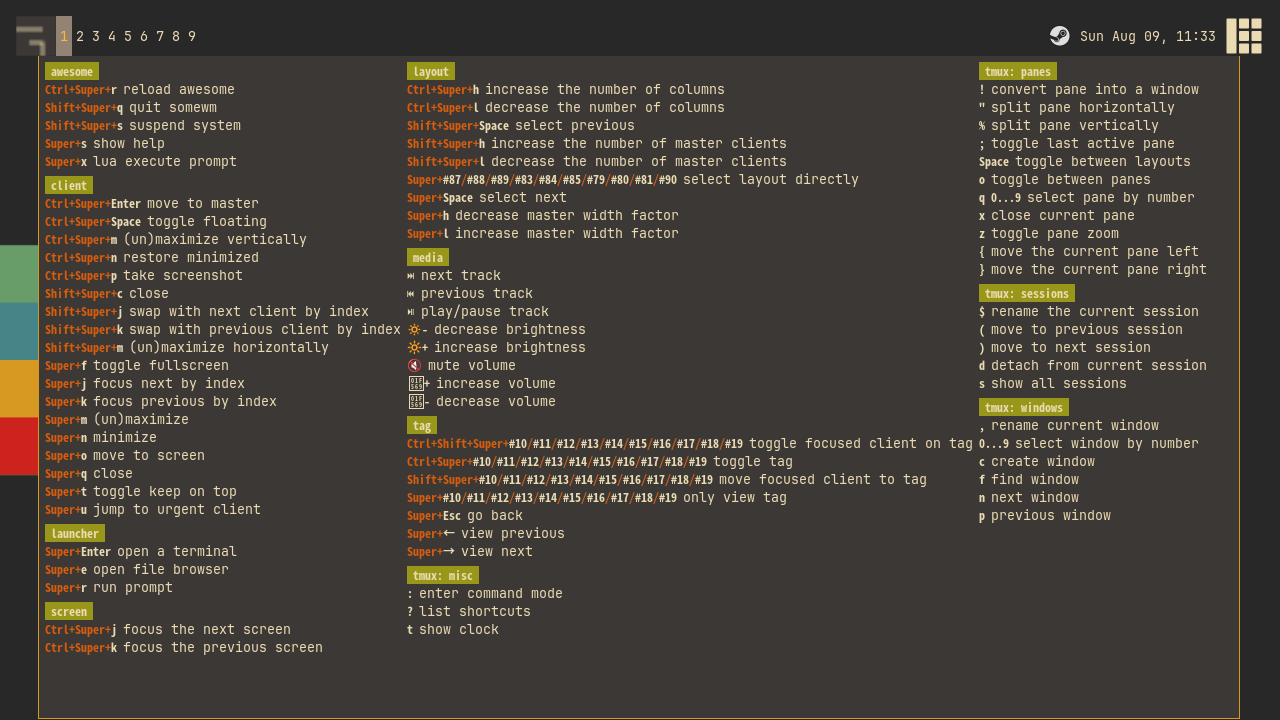
Checkpoint
The finished code is on the 02-keybindings branch.
git checkout 02-keybindings
somewm-client test start --config "$PWD/rc.lua" --name afs
Compare your work: git diff 01-theme 02-keybindings