kiln.widgets.clock
A clock updated at minute boundaries.
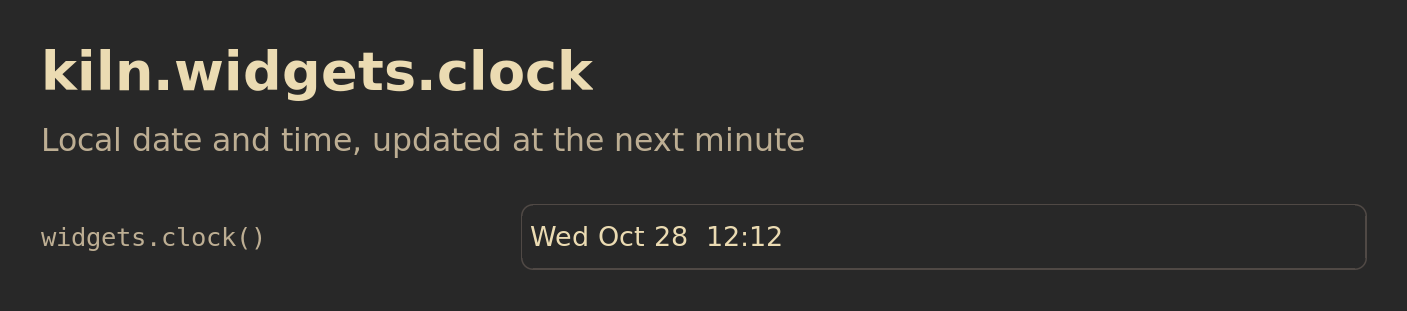
The capture uses the session’s local time.
Show Lua
Save the Lua file as /tmp/kiln-figure.lua, then run:
kiln-client eval 'dofile("/tmp/kiln-figure.lua")'
It opens on the focused screen and closes after two minutes. To close it early:
kiln-client eval 'if kiln_reference_figure then kiln_reference_figure.stop() end'
local kiln = require("kiln")
local ui, widgets = kiln.ui, kiln.widgets
if kiln_reference_figure then kiln_reference_figure.stop() end

local F = {
  bg = "#282828", fg = "#ebdbb2", panel = "#32302f", slot = "#504945",
  muted = "#bdae93", amber = "#d79921", blue = "#83a598", green = "#b8bb26",
  width = 940, label_width = 300,
}
function F.text(text, cfg)
  cfg = cfg or {}
  cfg.color = cfg.color or F.fg
  cfg.font = cfg.font or "Sans"
  cfg.size = cfg.size or 19
  ui.text(text, cfg)
end
function F.block(text, cfg)
  cfg = cfg or {}
  ui.box({ w = cfg.w or 72, h = cfg.h or 30, color = cfg.color or F.blue,
    radius = 4, align = "center" }, function()
    F.text(text, { color = F.bg, size = 16 })
  end)
end
function F.row(label, draw, opts)
  opts = opts or {}
  return function()
    ui.row({ w = "grow", gap = 20, align = { y = "center" } }, function()
      ui.box({ w = F.label_width }, function()
        F.text(label, { font = "monospace", size = 17, color = F.muted })
      end)
      ui.box({ w = "grow", h = opts.h or 44, pad = opts.pad or 6,
        radius = 8, border = { width = 1, color = F.slot },
        align = { y = "center" } }, draw)
    end)
  end
end
function F.scene(title, subtitle, rows, opts)
  opts = opts or {}
  local s = screen.focused or screen.all()[1]
  assert(s, "a screen is required")
  local popup = ui.popup {
    id = "kiln-reference-figure", screen = s, w = F.width, pad = 28, gap = 12,
    color = F.bg, fit = false, band = opts.band,
    fn = function()
      F.text(title, { size = 36, font = "Sans Bold" })
      F.text(subtitle, { size = 21, color = F.muted })
      ui.box({ h = 6 })
      for _, row in ipairs(rows) do row() end
    end,
  }
  local figure = { popup = popup, screen = s }
  function figure.stop()
    popup:destroy()
    if figure.timer then core.timer_cancel(figure.timer); figure.timer = nil end
    if kiln_reference_figure == figure then kiln_reference_figure = nil end
    if figure.cleanup then figure.cleanup() end
  end
  kiln_reference_figure = figure
  figure.timer = core.timer(120000, figure.stop)
  popup:show(s)
  return figure
end
function F.clients(count)
  local result = {}
  for _, c in ipairs(client.all()) do
    if c.mapped and not c.override_redirect then result[#result + 1] = c end
  end
  assert(#result >= count, "open " .. count .. " clients before running this figure")
  return result
end
function F.client_scene(title, subtitle, rows, opts)
  local previous = kiln.declare_clients
  local replacement = function() end
  kiln.declare_clients = replacement
  local figure = F.scene(title, subtitle, rows, opts)
  figure.cleanup = function()
    if kiln.declare_clients == replacement then kiln.declare_clients = previous end
    kiln.dirty()
  end
  return figure
end

return F.scene("kiln.widgets.clock", "Local date and time, updated at the next minute", {
  F.row('widgets.clock()', function() widgets.clock() end),
})
widgets.clock()
Example
widgets.clock()
Options
This function takes no cfg table.
Behaviour
Draws os.date("%a %b %d %H:%M") in the theme font. The first declaration arms a shared timer for 50 ms after the next minute boundary. Each timer dirties all screens and rearms. Reload cancels it; the next declaration starts it again.
There are no format or colour arguments. For another format, use ui.widget with every and ui.text, as in the widgets tutorial.
Widget conventions cover declaration, state and IDs.