kiln.ui.surface
Places a client's surface tree at the solved box to display client content.
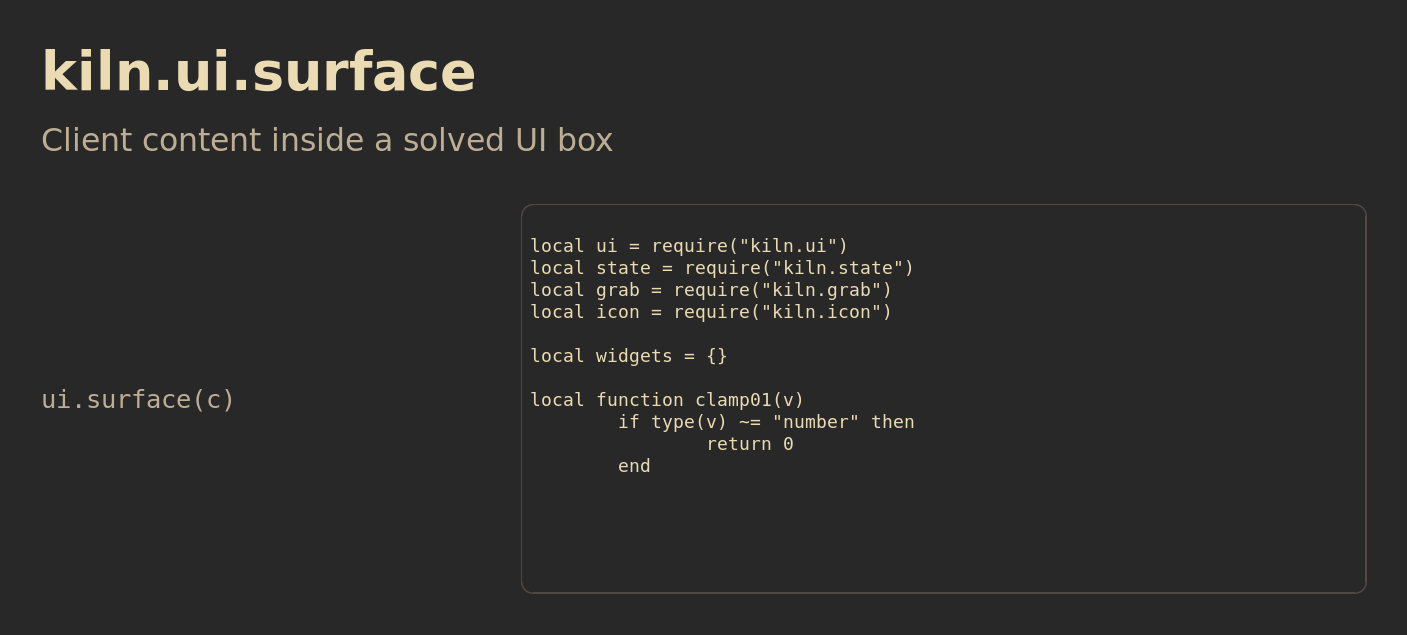
Only client content is placed inside the sample box.
Show Lua
This example temporarily replaces the client layout. Closing the figure restores it.
Requires one open client.
Save the Lua file as /tmp/kiln-figure.lua, then run:
kiln-client eval 'dofile("/tmp/kiln-figure.lua")'
It opens on the focused screen and closes after two minutes. To close it early:
kiln-client eval 'if kiln_reference_figure then kiln_reference_figure.stop() end'
local kiln = require("kiln")
local ui, widgets = kiln.ui, kiln.widgets
if kiln_reference_figure then kiln_reference_figure.stop() end

local F = {
  bg = "#282828", fg = "#ebdbb2", panel = "#32302f", slot = "#504945",
  muted = "#bdae93", amber = "#d79921", blue = "#83a598", green = "#b8bb26",
  width = 940, label_width = 300,
}
function F.text(text, cfg)
  cfg = cfg or {}
  cfg.color = cfg.color or F.fg
  cfg.font = cfg.font or "Sans"
  cfg.size = cfg.size or 19
  ui.text(text, cfg)
end
function F.block(text, cfg)
  cfg = cfg or {}
  ui.box({ w = cfg.w or 72, h = cfg.h or 30, color = cfg.color or F.blue,
    radius = 4, align = "center" }, function()
    F.text(text, { color = F.bg, size = 16 })
  end)
end
function F.row(label, draw, opts)
  opts = opts or {}
  return function()
    ui.row({ w = "grow", gap = 20, align = { y = "center" } }, function()
      ui.box({ w = F.label_width }, function()
        F.text(label, { font = "monospace", size = 17, color = F.muted })
      end)
      ui.box({ w = "grow", h = opts.h or 44, pad = opts.pad or 6,
        radius = 8, border = { width = 1, color = F.slot },
        align = { y = "center" } }, draw)
    end)
  end
end
function F.scene(title, subtitle, rows, opts)
  opts = opts or {}
  local s = screen.focused or screen.all()[1]
  assert(s, "a screen is required")
  local popup = ui.popup {
    id = "kiln-reference-figure", screen = s, w = F.width, pad = 28, gap = 12,
    color = F.bg, fit = false, band = opts.band,
    fn = function()
      F.text(title, { size = 36, font = "Sans Bold" })
      F.text(subtitle, { size = 21, color = F.muted })
      ui.box({ h = 6 })
      for _, row in ipairs(rows) do row() end
    end,
  }
  local figure = { popup = popup, screen = s }
  function figure.stop()
    popup:destroy()
    if figure.timer then core.timer_cancel(figure.timer); figure.timer = nil end
    if kiln_reference_figure == figure then kiln_reference_figure = nil end
    if figure.cleanup then figure.cleanup() end
  end
  kiln_reference_figure = figure
  figure.timer = core.timer(120000, figure.stop)
  popup:show(s)
  return figure
end
function F.clients(count)
  local result = {}
  for _, c in ipairs(client.all()) do
    if c.mapped and not c.override_redirect then result[#result + 1] = c end
  end
  assert(#result >= count, "open " .. count .. " clients before running this figure")
  return result
end
function F.client_scene(title, subtitle, rows, opts)
  local previous = kiln.declare_clients
  local replacement = function() end
  kiln.declare_clients = replacement
  local figure = F.scene(title, subtitle, rows, opts)
  figure.cleanup = function()
    if kiln.declare_clients == replacement then kiln.declare_clients = previous end
    kiln.dirty()
  end
  return figure
end

local c = F.clients(1)[1]
return F.client_scene("kiln.ui.surface", "Client content inside a solved UI box", {
  F.row('ui.surface(c)', function()
    ui.surface(c, { w = "grow", h = "grow" })
  end, { h = 260 }),
})
ui.surface(c, cfg?)
Example
Inside a layout that receives client c:
ui.column({ w = "grow", h = "grow" }, function()
  kiln.widgets.titlebar(c, client.focus == c)
  ui.surface(c, { w = "grow", h = "grow" })
end)
Options
Without cfg, both axes use "grow". With a cfg table, omitted axes use
"fit". Accepts the element options.
The surface ID is
{ "core.surface", c.handle }; cfg.id does not replace it. Declare a client's
surface at most once per output. Duplicate IDs reject the frame.
For a titlebar, border and floating resize handles, use
widgets.client.